Personalized Career Guidance vs Generic Astrology
A generic astrology report explains broad chart characteristics. 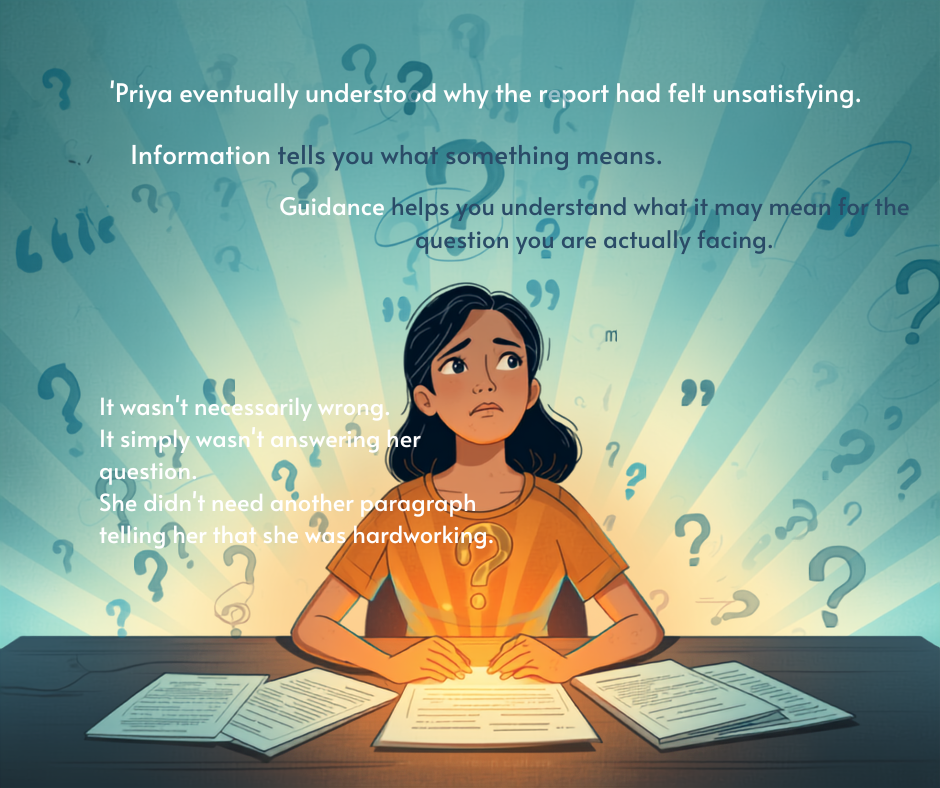
Frequently Asked Questions
Personalized guidance starts with the person's actual question.
The difference matters because career decisions are rarely just about: "What does my horoscope say?"
They are usually about: What is happening now?
Why does it feel difficult?
What are my options?
Is this a phase or a pattern?
Should I stay or move?
What should I prepare for?
When might a transition be more supportive?
What practical action should I take?
A useful Vedic career analysis should connect the birth chart, timing factors, current circumstances, and the specific question being asked.
The Report Said Everything.
Except What She Needed to Know. Priya had downloaded an astrology report because she had one question: "Should I change my job?" The report was impressive.
Pages of planetary positions. Descriptions of personality traits. Career predictions. General statements about success. There was even a section about Saturn. She read it twice. Then closed it. She still didn't know what to do. Her actual situation was complicated. She had been in the same company for six years. Her salary was reasonable.
Her manager had recently offered her more responsibility, but no clear promotion. She was tired. At the same time, she was afraid of leaving. And somewhere in the middle of all this, she wanted to know whether this was simply a difficult phase—or whether she had genuinely outgrown her career. The report couldn't answer that. Not because astrology was necessarily the problem. Because generic information was being used to answer a personal question.
A Horoscope Is Not the Same as a Conversation Imagine visiting a doctor and receiving a document describing your body without telling the doctor what hurts. The information may be accurate. But it doesn't necessarily answer your problem. Career guidance works similarly.
A chart contains many potential areas of interpretation.
But the relevance depends on the question.
Someone asking: "Will I get promoted?" needs a different analysis from someone asking: "Should I leave my company?"
And someone asking: "Why have I lost interest in my career?" may need a completely different conversation.
The chart doesn't change.
The question changes the lens through which the chart is examined.
The Same Chart Can Lead to Different Questions Consider three professionals.
Person A: Promotion "I've performed well for three years. Why am I not getting promoted?" Relevant exploration may include: Promotion → Leadership → Visibility → Career Timing → Dasha
Person B: Career Change "I've been successful, but I no longer enjoy my work." The conversation may move toward: Career Stagnation → Purpose → Career Change → Timing Person C: Burnout "I earn well, but I'm exhausted and can't continue like this." Now the relevant discussion may include: Burnout → Work-Life Balance → Leadership → Career Change → Purpose The same broad career indicators may be present.
But the decision context is different. That is why personalization matters. Vedic Astrology Is More Than One Planet Generic astrology often gets reduced to statements such as: "Saturn is delaying your career." That sounds simple. But traditional Vedic Astrology is considerably more nuanced. A serious career analysis may consider: Relevant houses. House lords. Planetary placements. Planetary strength. Dasha. Transits. Relationships between relevant factors. The broader chart context. Saturn may be relevant. But Saturn alone doesn't explain an entire career.
In traditional Jyotish, Saturn is associated with themes such as discipline, responsibility, patience, structure, persistence and gradual results.
The useful question isn't: "Is Saturn bad for me?"
It is: "How might Saturn's traditional themes relate to my current career situation?
" Dasha Gives Timing Context Another major difference between a generic report and personalized analysis is timing. A birth chart describes tendencies and potentials.
Dasha systems are traditionally used to examine planetary periods and their themes.
For a career question, the analysis may explore: What period is currently operating?
What themes are traditionally associated with it?
How does it interact with career indicators?
Does the period suggest consolidation, responsibility, learning, expansion or transition?
But there is an important rule: Timing is not destiny. A favourable period doesn't guarantee promotion. A challenging period doesn't mean failure. Real-world circumstances still matter. Context Changes the Meaning Imagine two people experiencing the same career-related planetary period.
One has: A supportive manager. Strong performance. An upcoming leadership opportunity. The other has: Severe workplace conflict. No growth path. Poor compensation. Persistent burnout. The same astrological period may be interpreted differently because their life circumstances are different. This is why personalized guidance should connect: Chart + Timing + Context + Question + Action rather than producing a fixed paragraph for everyone.
Personalization Also Means Asking Better Questions Sometimes the user's first question isn't the real question. Someone may ask: "Will I get promoted?" But what they really mean is: "Does my organisation value me?" Someone may ask: "Should I change jobs?" But the deeper issue may be: "I'm exhausted and don't know whether I need rest or change." Someone may ask: "When will my career improve?" But the real question could be: "Why am I no longer confident about my abilities?" Good guidance explores the question behind the question. Practical Advice Must Stay in the Conversation Vedic insight becomes more useful when it leads to reflection and action. For example: If you're experiencing career stagnation, don't simply wait for a favourable period. Ask: What skills am I missing? Have I discussed progression with my manager? Is my impact visible? What evidence supports my promotion case? What external opportunities exist? If you're considering a career change: Research the market. Update your CV. Speak with professionals. Understand compensation. Build financial runway. Test alternatives before resigning where practical. Astrology can provide a perspective. It should not replace common sense.
This Is Where AskVedicaa Is Different
Are generic astrology reports useless?
Not necessarily. They can provide general information about a chart. But they may not answer a specific personal question because they aren't built around your current circumstances.
Why is personalized astrology better?
Because the analysis can focus on the actual question, relevant chart factors, timing, circumstances and practical decision.
Can two people with similar charts receive different guidance?
Yes. Their life circumstances, questions, choices and timing context may differ.
Does AskVedicaa predict the future?
AskVedicaa provides Vedic guidance and interpretations. Its purpose is not to make deterministic guarantees about future events.
Can Vedic Astrology help with career decisions?
It can provide a traditional framework for reflecting on career tendencies, timing and phases. It should be combined with practical information and personal judgment.
Why does Dasha matter?
Dasha is traditionally used to interpret planetary periods and their themes, adding a timing dimension to chart analysis.
What role does Saturn play in career analysis?
Saturn is traditionally associated with discipline, responsibility, patience, structure and gradual results. Its significance depends on the broader chart and timing context.

Comments
Post a Comment